- calendar_today August 12, 2025
.
WASHINGTON, July 18, 2023 — It took less than three years for the U.S.-India relationship to go from one of the most successful post–Cold War strategic partnerships to one of its most serious tests. Washington and New Delhi had built the ties carefully over two decades, only for the relationship to fray quickly as tariffs, oil politics, and other diplomatic maneuvers have come into play.
“The trust is gone,” said Evan Feigenbaum, a South Asia analyst at the Carnegie Endowment for International Peace, of the ties between the two countries. “We’re in a situation in the U.S.-India relationship where the premises and assumptions of the last 25 years — that everybody worked very hard to build, including the president in his first term — have just come completely unraveled.”
This decline in trust has been brought on by a slew of factors, with the catalyst being Trump’s broad tariffs on Indian goods this year over New Delhi’s continued purchase of Russian oil, despite its invasion of Ukraine. The tariff initially stands at 25 percent but will ratchet up to 50 percent from August 27, 2023. Far from incentivizing India to cut its Russian oil imports, the tariffs seem to have pushed the South Asian country further into Moscow’s and Beijing’s arms.
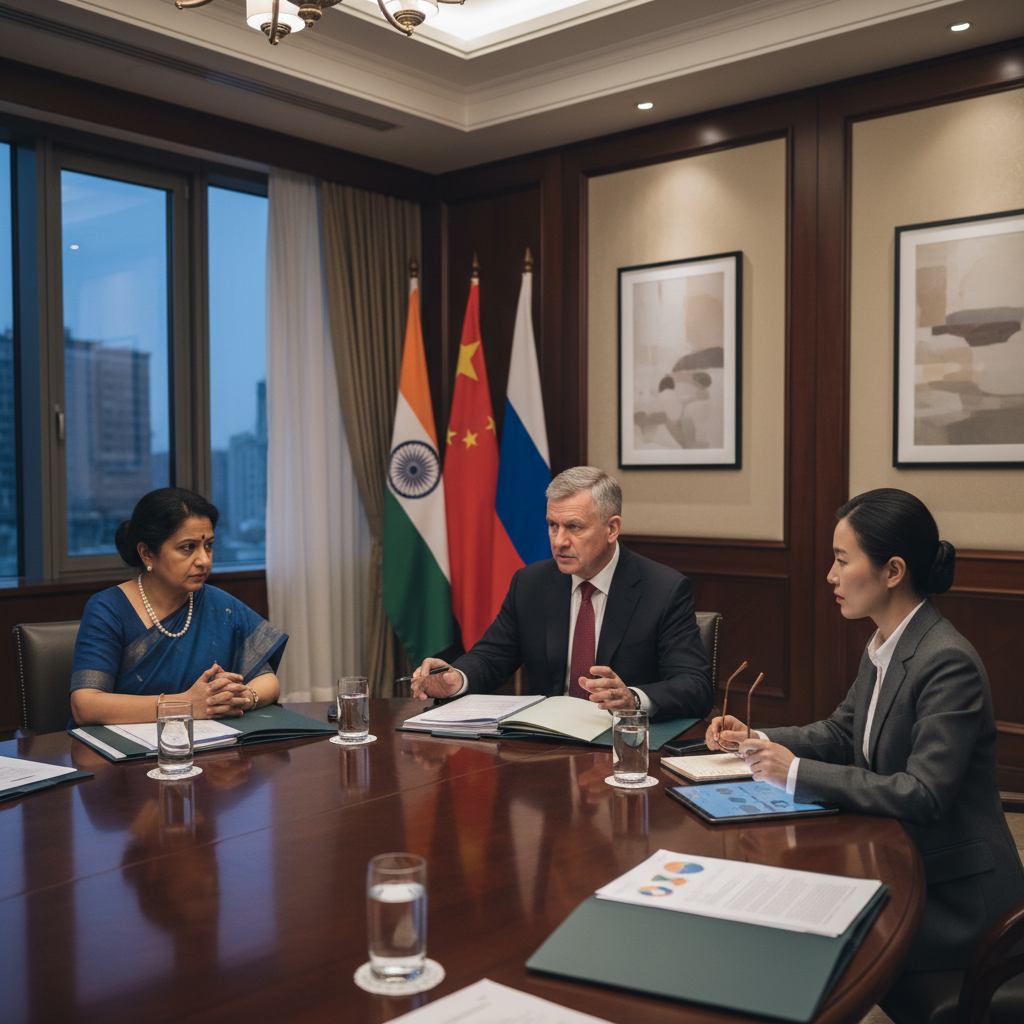
India’s national security adviser went to Moscow last month, Foreign Minister Subrahmanyam Jaishankar held talks there last week, and China’s Foreign Minister Wang Yi concluded discussions in New Delhi on Tuesday. Modi is also set to visit China for the first time in more than seven years, and Russian President Vladimir Putin will likely host him in Moscow before the end of the year. The moves are not only symbolic, either, according to analysts.
Indian public opinion has been galvanized against perceived U.S. interference in India’s sovereign policy decisions. “They’re signaling very clearly that they view that as interference in India’s foreign policy, and they are not going to put up with it,” Feigenbaum added.
Although New Delhi stalled its oil imports from Russia for a few weeks at the onset of the Ukraine war, its state-run refiners resumed Russian oil imports after receiving discounts of between 6 percent and 7 percent. That’s led to a reordering of the global oil trade. “Russia has now replaced Iraq as India’s second-biggest oil supplier, sending a fifth of the country’s crude imports,” according to Reuters.
For its part, Russia has further sweetened the deal. Deputy Prime Minister Denis Manturov told Russian news agency Interfax that Moscow “will continue to supply oil, oil products, thermal coal and coking coal to India.” It’s also seeing “potential for the export of Russian LNG.”
Further, the current tariffs “come at a time when India was already trying to figure out how to manage relations with China and Russia,” said Michael Kugelman, a South Asia analyst at the Washington-based Wilson Center. “Trump’s tariffs, not the only factor, have really spurred India on in that regard.”
There will be some performative aspects to the diplomatic push to Russia and China. “But India is going to double down on some aspects of its economic and defense relationship with Russia — and those parts are not performative,” Feigenbaum said.
India has been weaning itself off of Russian weapons in recent years, replacing the Moscow systems with weapons from the U.S., France, and Israel. After the Russian invasion of Ukraine, however, India’s energy trade with Russia has sharply increased. It’s a reminder that even as India has taken the first steps to integrate its economy with the U.S. and the West, “India feels like it’s in the same old game — that the U.S. can’t be trusted, whereas Russia can — because Russia is always going to be there for India no matter what,” Kugelman said.
Domestically, Modi has been bolstered by his image as a strongman who’s pushing back against international pressure. India is “sending a signal that it has priorities other than deference to Western concerns, and that those priorities include the livelihoods of Indian farmers, small businesses, and young workers,” said Kugelman. “That’s got enormous resonance back home in India.”
Recall that India had given in to U.S. demands to return workers stranded in the Gulf and to drop its tariffs, so it “needs to be careful about signaling further willingness to bend,” Kugelman said. “This is one reason there was no trade deal — Modi put his foot down.”
It’s a source of frustration in Washington, where, in an op-ed in the Financial Times, former White House trade adviser Peter Navarro said India’s oil purchases were “opportunistic,” “deeply corrosive,” and something that Trump is “correctly punishing.” Navarro argued that “tariffs are how the U.S. government stops Indian commercial predation — by going right where it hurts: its access to U.S. markets — even as it seeks to cut off the financial lifeline it has extended to Russia’s war effort.”
It’s a far cry from the era of the 2008 U.S.-India civil nuclear deal that allowed New Delhi to import nuclear fuel and technology from the U.S. despite not signing the Non-Proliferation Treaty, which the South Asian country deemed discriminatory.