- calendar_today August 13, 2025
In 2025, Missouri’s commercial real estate (CRE) market is stabilizing after several years of disruption and adaptation. While uncertainty in interest rates and capital flows continues to weigh on certain sectors, pockets of growth—particularly in industrial, multifamily, and mixed-use development—are reshaping the landscape across the state.
From the urban cores of St. Louis and Kansas City to emerging markets like Columbia and Springfield, the state’s CRE players are reevaluating strategies to stay competitive in a post-pandemic economy shaped by remote work, rising construction costs, and changing tenant priorities.
Here’s a closer look at the trends defining Missouri’s commercial real estate recovery in 2025.
1. Office Markets Face Uneven Recovery in St. Louis and Kansas City
Missouri’s office market continues to evolve in response to permanent shifts in workplace habits. In downtown St. Louis, Class A buildings are seeing moderate leasing activity from healthcare, law, and tech firms, but overall vacancy remains high—hovering around 25%, according to Cushman & Wakefield.
Kansas City is faring somewhat better, especially in its Country Club Plaza and Overland Park submarkets, where Class A office occupancy has stabilized closer to 18%. Tenants continue to downsize footprints and favor flexible lease terms, focusing on quality amenities, energy efficiency, and transit accessibility.
Suburban office markets in Chesterfield, Creve Coeur, and Lee’s Summit are seeing increased demand for smaller spaces that support hybrid work and proximity to residential communities.
2. Industrial Real Estate Remains Missouri’s Strongest Sector
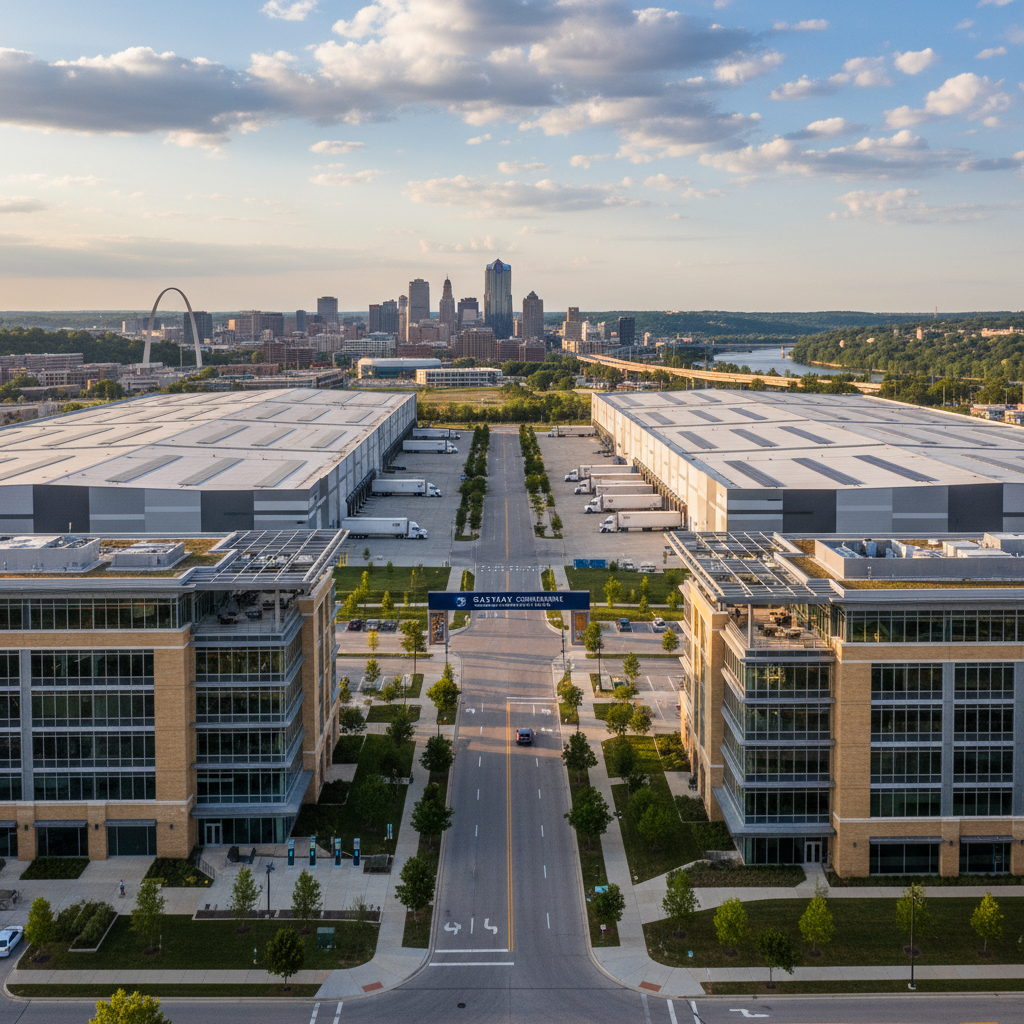
Industrial real estate is Missouri’s most robust commercial sector in 2025. The state’s location along major logistics corridors—I-70, I-44, and I-55—has made it a strategic hub for distribution, manufacturing, and e-commerce fulfillment.
In Kansas City, the Logistics Park in Edgerton and new developments in Northland continue to attract large-scale users. Vacancy rates across the metro hover around 4.1%, with rents continuing to climb.
St. Louis has also seen strong industrial absorption, particularly in Hazelwood, Earth City, and Madison County, Illinois, just across the river. Developers are targeting cold storage, food-grade facilities, and last-mile distribution centers.
While speculative development has slowed due to higher borrowing costs, build-to-suit projects remain active, especially near the airport corridors and regional rail hubs.
3. Retail Centers Shift Focus to Mixed-Use and Essential Services
Retail real estate in Missouri is evolving from traditional formats to more service-oriented, mixed-use destinations. Enclosed malls such as Independence Center in Kansas City and South County Center in St. Louis are undergoing partial redevelopments, converting vacant anchor spaces into medical offices, gyms, and co-working hubs.
Meanwhile, open-air shopping centers and grocery-anchored plazas remain stable. Hy-Vee, Schnucks, and Walmart Neighborhood Markets continue to anchor retail nodes that draw steady foot traffic.
Smaller cities like Columbia and Cape Girardeau are seeing increased interest in lifestyle centers that combine dining, retail, and entertainment—catering to shifting consumer preferences for convenience and walkability.
4. Multifamily Development Slows but Demand Persists
The multifamily market in Missouri remains healthy, even as the pace of new development slows in response to rising interest rates and construction costs. Kansas City’s urban core and St. Louis’ Central West End continue to attract young professionals and healthcare workers, keeping demand high for Class A rentals.
Rent growth across Missouri has moderated to around 3.8% annually in 2025, but occupancy remains strong, particularly in mid-market and workforce housing. Garden-style apartments in Springfield, Columbia, and St. Charles have experienced lower vacancy rates compared to luxury high-rises.
Student housing near the University of Missouri in Columbia and Missouri State University in Springfield has also rebounded strongly post-COVID, with developers exploring new infill opportunities.
5. Capital Markets Tight but Stabilizing
Investment activity across Missouri’s commercial sectors slowed in early 2025 due to continued caution from lenders and buyers. According to Real Capital Analytics, statewide CRE transaction volume dropped 28% year-over-year in Q1 2025.
However, private equity, family offices, and local investors are stepping into the void left by national institutional players. Industrial and multifamily assets with stable cash flows remain attractive, particularly in Kansas City’s northern suburbs and St. Louis County.
Value-add opportunities in office and retail are starting to emerge, with investors targeting distressed properties for repositioning—often supported by local economic development incentives.
6. Regional Growth Corridors Attract Development Activity
Outside the major metros, Missouri’s secondary cities are gaining investor interest due to their lower costs, strong local economies, and proximity to state universities or healthcare hubs.
- Columbia is benefiting from its central location and strong education sector. Mixed-use developments near the university are in demand.
- Springfield is seeing rising demand for multifamily and small-scale industrial space. Its affordability and logistics access are making it a regional magnet for new residents.
- St. Joseph and Jefferson City are also being explored for smaller distribution hubs and medical office redevelopment.
These markets offer lower entry points for investors and developers, especially as urban core land values remain high.
7. Public Incentives and Infrastructure Funding Support Redevelopment
Missouri continues to utilize public financing tools to spur commercial redevelopment in underserved areas. Tax Increment Financing (TIF), Enhanced Enterprise Zones (EEZs), and Low-Income Housing Tax Credits (LIHTC) are being deployed across the state.
The federal Infrastructure Investment and Jobs Act has unlocked new funding for transportation and broadband expansion in Missouri, supporting industrial growth and reshaping logistics capabilities in rural regions.
St. Louis and Kansas City are also actively pursuing brownfield redevelopment and transit-oriented development (TOD) projects, using incentives to transform underused corridors into mixed-use districts.
8. ESG and Adaptive Reuse Gaining Momentum
Environmental and social sustainability is becoming a key consideration in Missouri’s commercial real estate strategy. Developers are incorporating green building materials, EV charging stations, and energy-efficient systems to meet tenant expectations and local requirements.
In St. Louis, the Cortex Innovation District and Downtown West are examples of adaptive reuse at scale—repurposing warehouses and industrial buildings for tech, biotech, and creative industries.
Kansas City’s Crossroads Arts District continues to evolve as a model for walkable, adaptive reuse that attracts startups, galleries, and co-working firms.
Missouri’s 2025 CRE Outlook: Moderated Optimism with a Focus on Fundamentals
Missouri’s commercial real estate market in 2025 is best described as cautiously optimistic. While capital constraints and high construction costs remain, demand is holding steady in key asset classes—particularly in logistics, workforce housing, and experience-driven retail.
Key takeaways:
- Industrial and multifamily remain investment bright spots, supported by logistics strength and affordable housing demand.
- Office and retail are transitioning, with repositioning and adaptive reuse driving long-term value.
- Regional markets and secondary cities are gaining traction, offering better yields and development potential.
- Public-private partnerships and strategic incentives are key to unlocking new CRE growth statewide.
As Missouri leans into its geographic advantages, diversified economy, and strong public institutions, its commercial real estate sector appears well-positioned for a steady, albeit selective, recovery in the years ahead.