- calendar_today August 19, 2025
Subtitle: Schools worldwide, including Missouri, are shifting toward bilingual and multilingual instruction—boosting equity, cognition, and global career readiness.
Global Classrooms Go Multilingual in 2025
Hook: In a class in Geneva, students habitually change between three languages: French, English, and Arabic. California’s kindergarteners sing in Spanish and English. Schools around the world are rediscussing the importance of language, not just as a subject but as a critical tool of learning and communion.
Multilingual Roots Take over the Mainstream
The popularity of multilingual education is spreading across continents. By 2025, the movement will no longer be an immigrant movement or the preservation of a language. Instead, it will train students for jobs in an international labour market and ever-more interrelated societies.
The OECD’s 2025 Future of Education document reports that schools that provided bilingual or multilingual instruction demonstrated increased literacy, cultural awareness, and problem-solving results. At the same time, UNESCO’s Global Education Monitoring Report shows that multilingual education is an instrument for equality, particularly for minority and Indigenous students.
Governments are responding. Dual-language immersion programs in the United States have increased 35% since 2019. South Africa is required to adopt mother-tongue education up to grade 6 in a 2024 education reform. At the same time, trilingual pilot schools have been started in Finland, India, and the UAE.
Language Skills Now Considered Indispensable, Not Optional
This change is about communication, cognition, inclusion, and opportunity. Research indicates that multilingual students perform better than their monolingual counterparts in memory, attention, and executive functioning.
What is more important, learning several languages facilitates social integration. Students from different backgrounds feel seen and are deeply supported in school if their home language is valued, which makes them more involved and courageous.
In a country where bilingualism is part of being Canadian, schools are now incorporating Indigenous languages into the curricula, especially in the territories. Indian’s New Education Policy (NEP) accepts multilingual instruction during the initial stages to build a sense of conceptual understanding and cultural roots.
The adoption of AI-powered translation tools is also being accelerated. Real-time captioning, language-switchable eBooks, and adaptive assessments assist teachers in modifying content to meet the requirements of the learners. Improvement efforts made by Microsoft through the implementation of tools such as Microsoft Immersive Reader and even Google’s real-time subtitles are now being incorporated directly into school tech.
Inside the New Multilingual Classroom
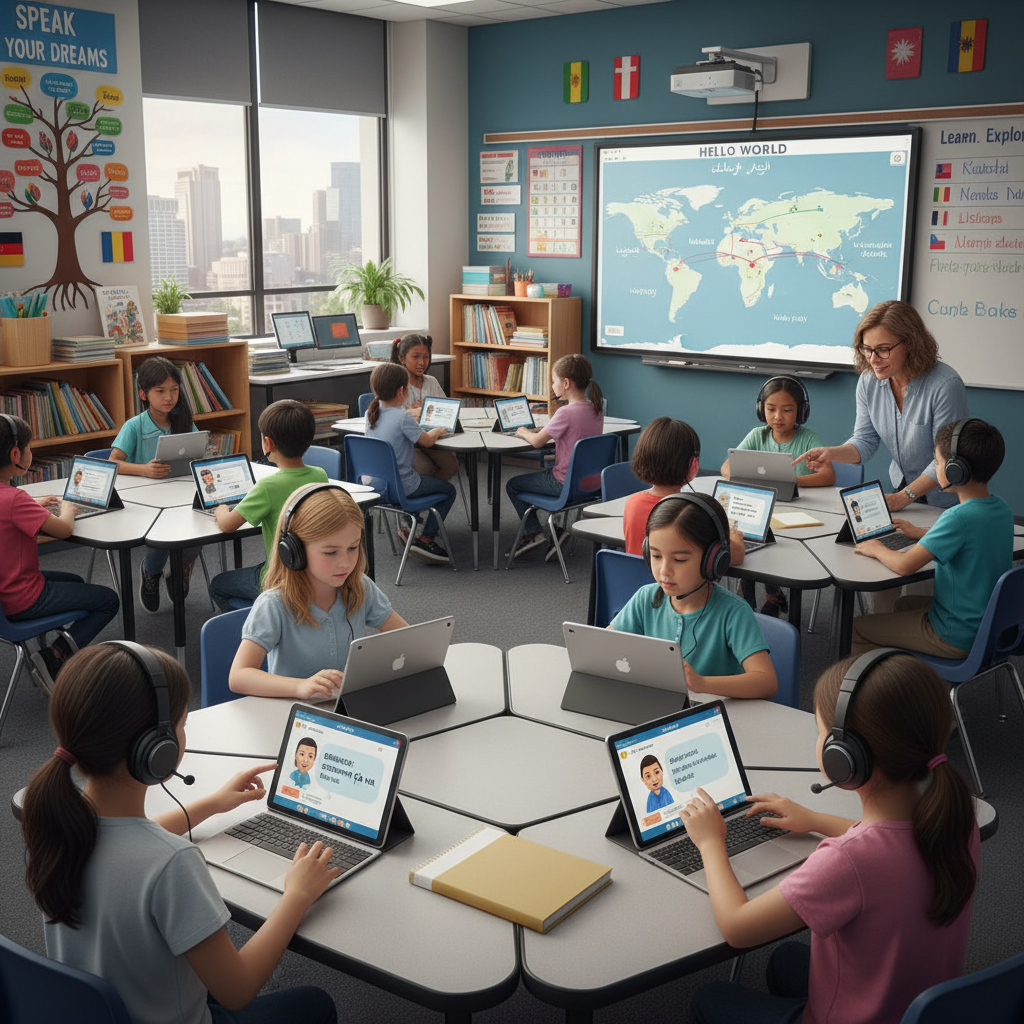
Multilingual learning is changing. Schools are redesigning the classroom so all students benefit from language-rich instruction instead of being separated by language.
In the U.S., the award of the seal of biliteracy in 49 states prompts high schoolers to become proficient in at least two languages before graduating from high school. France and Germany collaborate on cross-border “language bridges,” whereby students in border towns learn both languages.
Kenya has a new government-led campaign that teaches teachers how to teach science and math using local languages. However, when students reach the later grades, they study in English—a model now seen across East Africa.
Learners in Missouri Leading the Way
Educators and community-based groups in Missouri (Kansas City, St. Louis) have teamed up to start specialized multilingual programs. Regional cultural practices are used to present the workshops of dual-language pedagogy in local teacher-training institutes. Digital learning space and reflection journal have been translated into local dialects, ensuring all students fully participate in class. Government and NGO “Language Resource Hubs” exchange lesson plans, success stories, and digital tools, on the one hand, the urban language-immersion labs, on the other, the rural mother-tongue classrooms, to scale them out across the region.
The Future: Flexible Fluency for the Global Generation
The future of learning a language is not to swap one tongue for another—it’s all about flexibility. Multilingualism has been evolving into a career asset in a world dominated by global business, migrations, and digital communication.
Yet challenges remain. Many schools lack trained bilingual educators. Parents fear that learning a minority language might slow English fluency. The standardized testing system neglects linguistic diversity.
Still, momentum is building. A recent statement by a UNESCO education director reads, “Multilingualism is not a problem to solve—it’s a solution to inclusion.” From Nairobi to New York, multilingual classrooms are more diverse and better prepared for the world the students will inherit.