- calendar_today August 14, 2025
.
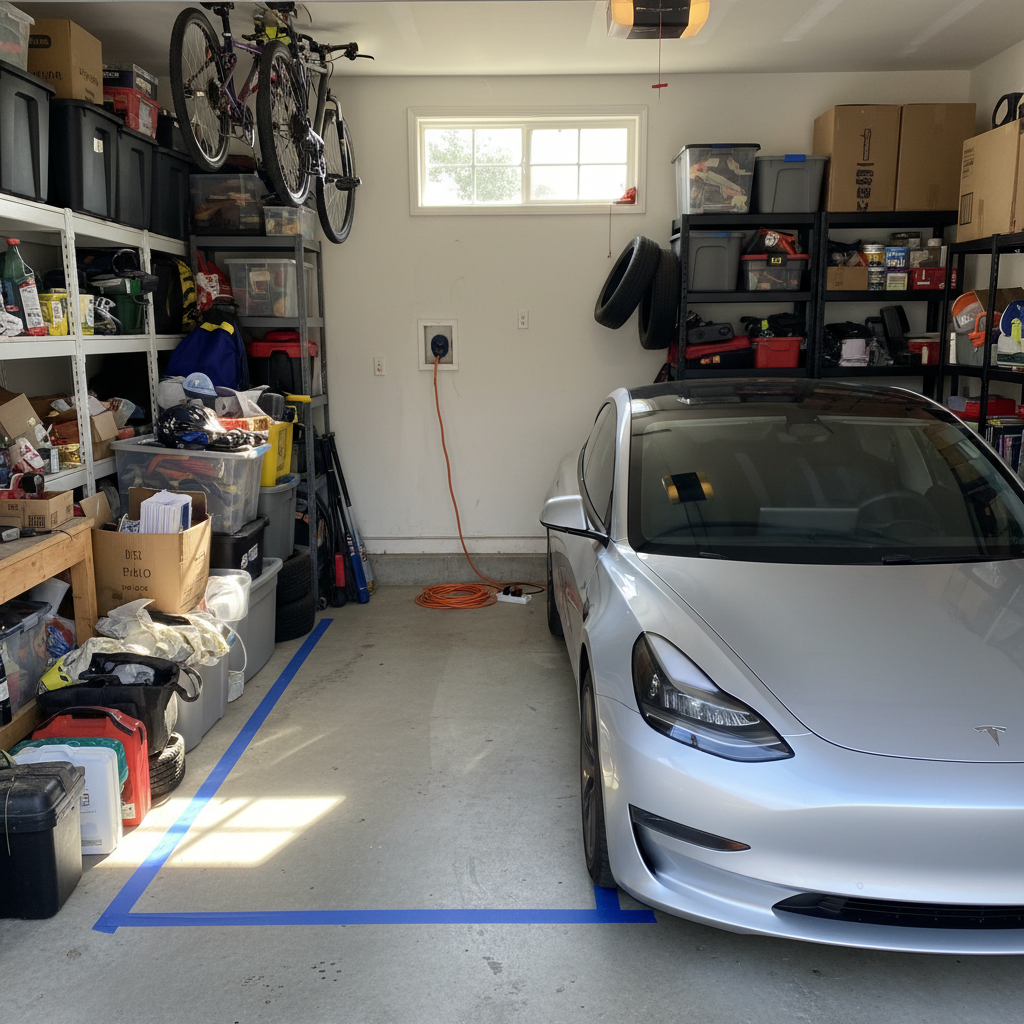
EV sales are stagnating and potential charging capacity is getting blocked by homeowners’ cluttered garages. Image: Getty
U.S. electric vehicle sales may have hit their tipping point. After more than a year of consistent month-over-month growth, EV sales in May contracted for the first time. Automakers like Genesis and Volvo are finding consumers are shunning electric cars, and they are looking to pare back those models.
The Biden administration’s cut in subsidies and vehicle pollution regulation could also be dampening sales, leaving would-be buyers with fewer federal incentives. However, the biggest hurdle to mass EV adoption in the U.S., some analysts say, is not political. It’s in Americans’ garages.
Charge Your Car Where You Park It
Consumer surveys have long indicated range anxiety is the top reason people aren’t buying EVs. Charging in general, and access to fast chargers in particular, are the key challenges EV advocates are trying to address.
A new report from Telemetry Vice President Sam Abuelsamid, however, points to one oft-overlooked charging problem: garages. Despite all the news about fast chargers, three out of four EV charges are expected to continue to occur at home, the Telemetry report said. The majority of those charges are by AC power, usually at a single-family home.
Data from the National Renewable Energy Laboratory (NREL) found that 42 percent of U.S. homeowners currently have a garage or other parking space near a wall outlet compatible with level 2 (240-volt) chargers.
That number could increase significantly, the Telemetry report said. If owners moved cars into garages or parking spots near a home’s electrical panel, that 42 percent figure could rise to 68 percent of U.S. households.
Abuelsamid noted, “90 percent of all houses can add a 240 V outlet near where cars could be parked. Parking behavior, namely whether homeowners use a private garage for parking or storage, will likely become a key factor in EV adoption.”
If more homeowners parked cars in garages rather than using them as storage, that 42 percent of U.S. homes with an outlet near a garage or parking spot could more than double, the report said. The number of homes with a charger-capable outlet and at least some off-street parking would rise from 31 million to over 50 million homes. Include homes where new wiring is possible, and that number could increase to over 72 million.
That number exceeds even Telemetry’s most bullish EV penetration forecast through 2035, which calls for 33 million to 57 million U.S. EVs.
Slow Charging Cost Barriers
Of course, capacity on paper doesn’t necessarily mean owners will or can be ready, willing, and able to charge at home. The same NREL study found nearly 34 million homes would need a level 2 charger to do some expensive electrical work, such as upgrades to the panel and new wiring.
Such upgrades can cost a minimum of a few hundred dollars but could run in the thousands if a new electrical panel and wiring are needed.
A key part of EVs’ long-term value proposition is that their operating costs are lower than those of gas-powered cars. Adding in the cost of EV charging hardware, including electrical upgrades, can put the total cost of ownership close to or even higher than a gasoline vehicle, depending on local electricity and fuel costs.
More Space, More Parking Spots for EVs
Limited space and restrictive home and apartment rules are other challenges. In multifamily housing units, like apartments, condos, and townhomes, homeowners don’t have the latitude to install charging stations and instead must seek approval from landlords, housing associations, or condo/co-op boards. Owners, with few exceptions, aren’t making it easy for EV owners.
“The overall financial hurdle is higher for the multifamily sector than for single-family homes,” the Telemetry report said. “Installing a pair of shared 240 V chargers at an apartment cooperative, for instance, may first require an electrical panel upgrade costing in the millions of dollars before chargers can be installed. Wiring also has to be run from the panel to parking spaces, which may be a significant distance away.”
This installation cost typically falls to the landlord or apartment management, but that can dissuade owners from offering an EV charger in the first place. And unlike a homeowner, residents of these apartments can’t take advantage of many government and municipal incentives and rebates that subsidize charger installation.
Current data show there are about 1 million EV owners living in multifamily housing, but just 11 percent park in a location that’s close enough to an outlet to charge at home, Telemetry found.
States have been pushing mandates that 20 to 25 percent of spaces in new multi-unit developments be EV-ready, but Telemetry still only estimates there will be 6.7 million to 11.4 million EV-capable spaces in these buildings by 2035. That total is well short of the market for EVs in those homes.
Public Charging to Step Up for Residential EV Adoption
Home charging won’t meet all residential EV drivers’ needs. Telemetry estimates between 11.7 million and 14.3 million EV drivers who own homes will still need public charging in 2035, as will 7.8 million to 8.1 million EV drivers in multifamily housing.
Meeting that need will take between 523,000 and 586,000 DC fast chargers, plus another 1.5 million to 1.6 million level 2 chargers across the country. That’s a tall order when power companies are already groaning under the demand for new AI data centers. Utility companies will likely need to plan for new EV charger load from residential growth, as well.
The EV future in the U.S. may not be as bright as in some markets. As attractive as the EV market in the U.S. may be, the road to mass adoption isn’t quite as rosy as it may look on paper. The U.S. could have the garage space to add charging to 72 million homes, but so far, garage clutter, high electrical upgrade costs, and the barriers of multifamily living have proven challenging for EV adoption.
Even with an aggressive public charging expansion, by 2035, those chargers may not be enough to keep up with demand. One thing seems clear: the future of EVs in the U.S. may depend as much on Americans’ garages as it does on Washington’s policies or automakers’ plans.