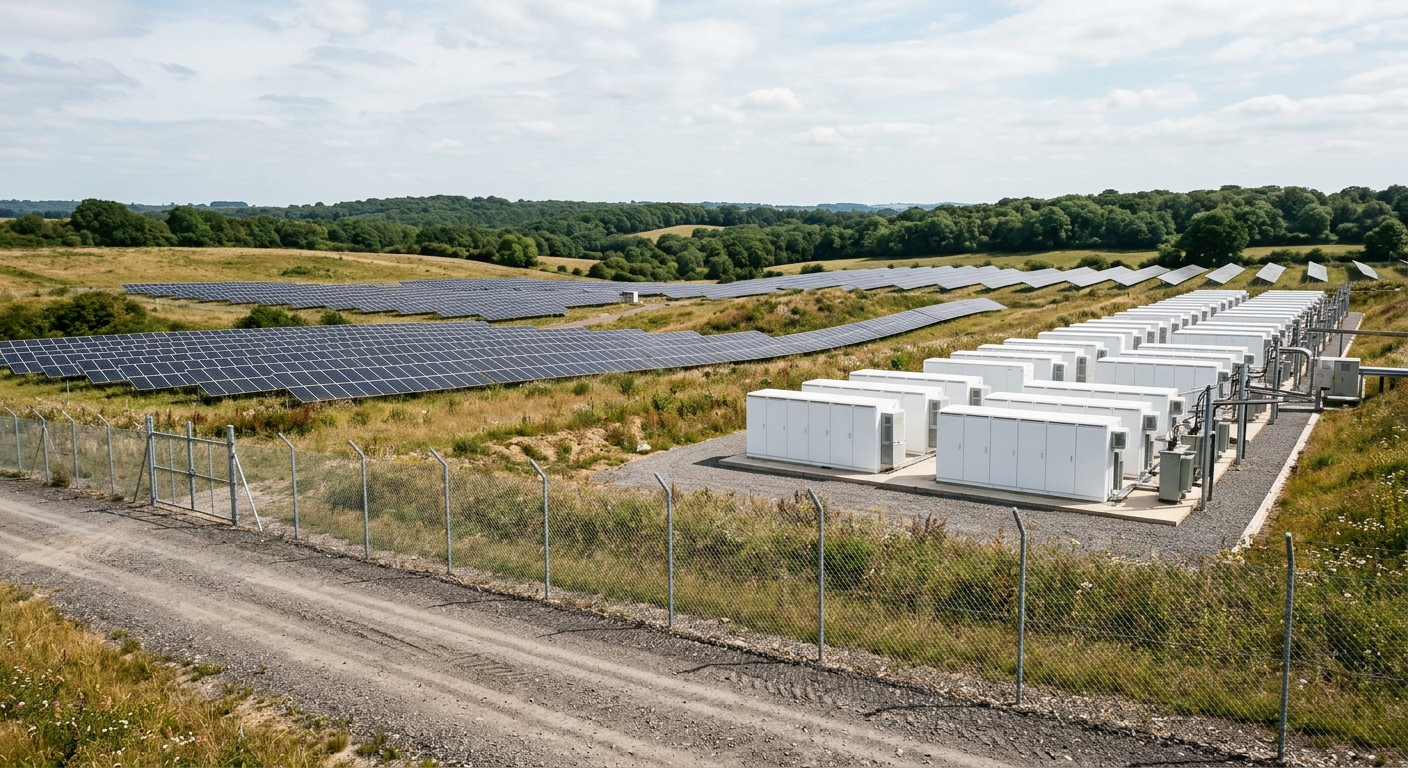
AI-generated illustration; not a photograph of the reported event.
- calendar_today October 28, 2026
Missouri PSC Grants Approval to Ameren Missouri’s Energy Storage and Solar Initiatives
The Missouri Public Service Commission (PSC) has approved an agreement permitting Union Electric Company, doing business as Ameren Missouri, to proceed with the development of several battery energy storage system (BESS) facilities, solar generation sites, and a new switching station. This decision follows a collaborative agreement signed by Ameren Missouri, the PSC Staff, and Renew Missouri, while the Office of the Public Counsel did not sign but raised no objection.
Details of the Approved Projects
The agreement covers three major battery energy storage projects, two solar generation projects, and the construction of a new switching station. The approved projects include:
- Castle Bluff BESS Project: A 95-megawatt (MW) battery storage system located at the retired Meramec coal facility in St. Louis County.
- Huck Finn BESS Project: A 200 MW battery energy storage facility at Ameren Missouri’s Audrain Energy Center in Audrain County.
- Millcreek BESS Project: A 250 MW battery energy storage installation in Lincoln County.
- Quinn Switching Station: A new 161-kilovolt switching station in Lincoln County designed to connect the Millcreek BESS to the existing transmission network.
- Tom Sawyer Solar Project: A 175 MW solar generation project in Audrain County.
- Ringer Solar Project: A 225 MW solar project in Stoddard County.
Customer and Safety Protections in Place
The Commission’s decision factors in safety and cost considerations, aiming to protect Ameren Missouri customers and address the interests of landowners near the project sites. The agreement imposes several obligations on Ameren Missouri to ensure transparency and community engagement, particularly around the Millcreek battery storage system project.
Ameren Missouri’s Obligations Under the Agreement
- Expand public information on community concerns related to the Millcreek BESS Project, including fire safety protocols, battery testing details, and local infrastructure impacts.
- Submit site-specific Hazard Mitigation Analysis or Hazard Mitigation Plans for each BESS facility after they go into service.
- Provide plans for restoring safe and adequate service following significant outages, along with site-specific hazard mitigation and environmental response procedures for the battery storage facilities.
- Address safety testing of BESS batteries prior to installation and demonstrate compliance with the National Fire Protection Association (NFPA) 855 standard for stationary energy storage systems.
- File procedures and best practices developed by Ameren’s Environmental team regarding environmental mitigation and fire response strategies after each facility is operational.
- Notify the Commission if a project’s total costs increase by more than 15% compared to base or risk-adjusted projections, explaining the reasons and cost-mitigation measures.
- Submit quarterly progress reports detailing construction milestones, permitting, costs, delays, and legislative or executive influences.
- Provide copies of all State, Federal, and Local permits obtained for each BESS project.
Safety Testing and Reporting Requirements
Ameren Missouri must coordinate with the PSC Staff and Office of the Public Counsel to discuss the results of safety testing for the Tesla Megapack 3, the designated battery storage technology. The company is required to file a public statement confirming the completion of safety testing, identify the results, and submit confidential safety testing reports for review by the Staff and OPC at least 90 days before battery installation at the Millcreek site.
Ensuring Accountability and Transparency in Renewable Energy Projects
The Commission’s conditional approval reflects increasing attention to battery energy storage, fire safety, hazard mitigation, and overall project cost transparency as Missouri expands its renewable energy infrastructure.
Source: suntimesnews.com.